
Finding Clarence Residents by Record
Use the type of fact already in hand. An address works best in the Town of Clarence assessor search or the Erie County map. A full name can be checked in the state voter form, a court party search, a deed index, or a historical directory. None of those sources is a complete list of everyone in Clarence. Property sources identify owners and tax-mail recipients. Court and deed records identify parties. Printed directories preserve a dated household clue. Matching two independent records is much stronger than relying on one result.
For a current question, begin with a parcel and preserve its SBL, the section-block-lot identifier used by local tax records. For an earlier question, preserve the printed spelling, year, and page. Those details make a later request to a Clarence office or library far more useful.
- Search the Clarence assessor portal by address or SBL and record the property location, owner field, mailing field, and deed book/page.
- Open Erie County GIS to confirm the parcel shape, address, and nearby map context.
- Use the book/page or party name in the Erie County Clerk index to identify a recorded document.
- For a name-based question, use the appropriate state voter or court portal within its stated limits.
- For a past household, compare a directory year with census, obituary, probate, or deed evidence.
Note: A Clarence result can establish a dated connection, but a single index entry does not prove that every person at an address lives there now.
Clarence Residents Records Offices
Four custodians supply most useful Clarence resident records. The Town Clerk keeps local vital, burial, minute, and FOIL routes. The Assessor ties a parcel to the current tax record. The Erie County Clerk holds recorded land documents. New York Courts publish separate civil and estate search routes. Each office has a different purpose, so a failed search in one is not a reason to treat a person as absent from Clarence.
Clarence Town Clerk and Tax Collector
One Town Place
Clarence, NY 14031
716-741-8938
Erie County Clerk
92 Franklin Street
Buffalo, NY 14202
Records request and terminal route
Clarence Parcel Records and SBLs
The Clarence PROS portal is the best opening move for a current property clue. It offers assessment information, property inventory, and comparable-sale material. Select Quick Property Search, open Search Filters and the Property Search Form, enter an address or SBL, submit, and then select the property address in the results. The annual assessment roll is a related snapshot, while the portal says its 2026 final values are uploaded.
| Clarence PROS field | Use | Search note |
|---|---|---|
| SBL | Tax-map parcel identifier | Copy the punctuation shown in the roll |
| Address | Property or situs address | Quick-search field |
| Sale Date Min | Comparable-sale filter | The guide suggests looking back two years |
| House Style, Square Feet, Acres | Comparable refinements | Advanced-search controls |
| Any / All criteria | Advanced search logic | Use before Submit Search |
PROS displays a property location and a current owner's address for tax correspondence. They may differ. The 2025 roll example at 8056 Tonawanda Creek Road has an East Amherst mailing address, which is a useful reminder not to turn a tax-mail field into an occupancy claim.
Erie Deed Trails for Clarence Names
Erie County's recorded-document search is valuable when a Clarence parcel leads to an owner or past transfer. It is not a street-address index. The county directs an address search through the parcel system first, then back to the Clerk with a deed book/page or instrument number. In BrowserView, useful choices include Party Name, Town, Document Type, Book/Page, Instrument/File Number, date range, Map Number, and Parcel ID. Results are party-oriented, and the detail screen can show the type, date, parties, consideration, legal fields, map fields, and linked documents.
This indirect address-to-parcel-to-book/page route is a local records quirk. Deed index coverage online begins in 1986, while deed images begin in 1960. Mortgages have a 1986 index and 1980 image start. Older work may require the alphabetical Graves Index volumes, a public terminal, or an office request. The full address workflow is developed on the Clarence street directory page.
- Parcel
- A mapped piece of land identified for tax and land-record work.
- Situs address
- The physical property location, not necessarily the owner's mail address.
- Index
- A searchable record of document details that may exist even when an image is unavailable.
- Criss-cross directory
- An address-based directory section that can point from a street to a historic household.
Current Clarence Resident Directories
A current Clarence residents directory is assembled from focused public sources. The table separates what each source can actually confirm. A parcel record can identify a current owner and mailing address, while a voter lookup is a limited registration check, not a public roster. Use the record's date, scope, and custodian before comparing results.
| Clarence source | Person or address clue | Custodian | Access path |
|---|---|---|---|
| PROS and assessment roll | Owner, situs, mailing field, SBL | Clarence Assessor | Portal, roll, or office help |
| GIS parcel layer | Mapped parcel, owner and mailing attributes | Erie County GIS | On-Map click and query |
| Recorded documents | Grantors, grantees, lien parties | Erie County Clerk | Index, image by cutoff, or office |
| Voter registration lookup | Individual registration status | New York elections | Name, county, birth date, ZIP |
| Court and estate indexes | Named case or estate party | New York Courts | Separate portal and clerk routes |
The Erie County On-Map viewer adds parcel geometry, aerial imagery, ZIP, school, legislative, water, wetland, flood, and soil layers. Its public-data disclaimer matters: the map can be stale, its boundary lines are not a legal survey, and the former direct parcel-to-tax link is gone.
A careful Clarence check also separates roles that a search screen can make look alike. The deed grantee is the party who received a transfer. A PROS owner field is a current assessment clue. A mailing address is where the tax notice goes. A directory entry is a historical listing at the time the volume was printed. A court party is connected to a filing. When two Clarence records agree on an address, date, spouse or household notation, SBL, or legal description, the match is more reliable. When they disagree, preserve both citations and ask the Clarence or Erie County custodian which record controls its own subject. That approach avoids making an unsupported current-residence claim from a valuable but limited source.
Note: Treat a Clarence owner field, a party name, and a registration result as different kinds of evidence, each tied to a date and source.
Clarence Voter and Court Checks
New York's voter registration lookup asks for county, last name, first name, date of birth, and ZIP. It can confirm a registration result under the state's rules. Election Law §3-103(5) limits voter-registration records to an elections purpose, and protected voters under §5-508 are confidential. An empty result can reflect a privacy rule, a form mismatch, or another limitation, not a conclusion about a Clarence address.
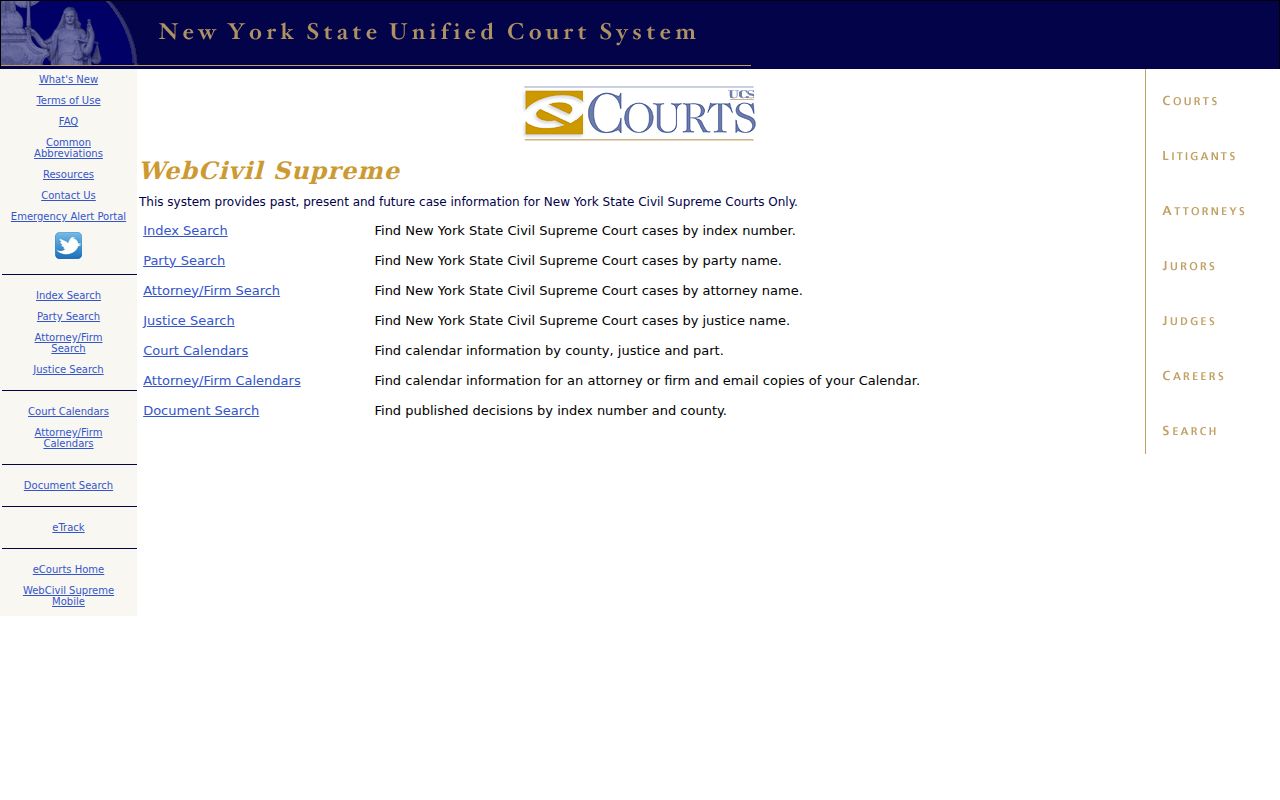
For court work, use WebCivil Local for the selected court's party or index search, WebCivil Supreme for Supreme Court civil matters, and WebSurrogate for estate and probate routes. A result may show the case or index number, court, parties, status, calendar information, and disposition where public. It confirms a filing connection, not residence or an allegation's merits.
The screenshot below comes from the New York WebCivil Supreme portal, where the tab selected determines the available name, index, county, date, court, or document controls.
Use a case number and the appropriate clerk for a file or certified record; sealed, family, youth, and other restricted matters are not an open Clarence directory.
Clarence Vital and Burial Routes
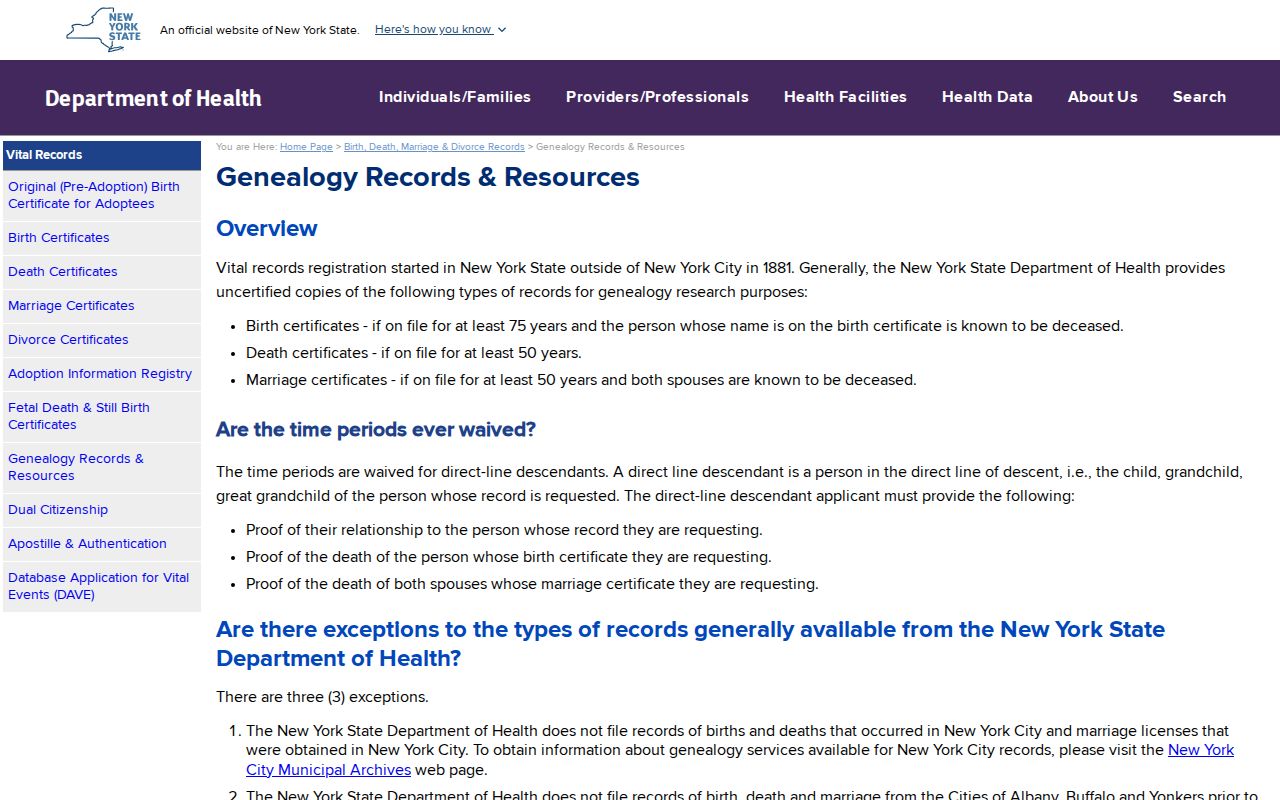
The Clarence Town Clerk records route is the local starting point for birth and death records from 1882, burial certificates, and eligible local copies. The town states a $10 certified-copy fee when the requester satisfies the person, family, or proof rules. For a statewide route outside New York City, the Department of Health handles certified and genealogy requests. Birth genealogy copies generally require 75 years and known death; death records require 50 years; marriage records require 50 years and known death of both spouses.
The NYSDOH genealogy service lists the period rules, fees, waiver information, and processing warning. Direct-line descendants may be able to waive waiting periods with proof. Vital records remain subject to their own confidentiality rules and are not opened simply by a FOIL request.
This state genealogy page shows the official route for a dated family-history request.
For a Clarence event, ask the local registrar first and give the full name, event type, approximate date, and any hamlet or address that helps identify the filing place.
Clarence Residents in Regional Directories
The historical Clarence residents directory trail is regional, not a continuous book published only for the town. The Grosvenor Room shelf list identifies an 1870 Buffalo Erie County Register and Business Directory covering Amherst, Clarence, Lancaster, and Newstead. It also identifies Erie County volumes for 1897/98, 1916/17, 1917, 1924, 1927, 1929, 1931, 1934, 1936, 1938, 1941, and 1949, plus a Buffalo Suburban catalog entry for Clarence from 1991 forward.
The digitized Buffalo City Directories cover 1832-1913, while the Buffalo Address Book and Family Directory spans 1883-1916. They can help when a Clarence household moved through Buffalo or when an address section provides context, but they do not prove a Clarence-only run. The complete local-history collection discussion belongs on the Clarence city directory page.
Clarence ZIPs and Postal Labels
Clarence's official ZIP map shows five practical postal areas: 14001, 14031, 14032, 14051, and 14221. The map's street index and grid are more useful than a generic ZIP list. Postal labels can read Akron, Clarence, Clarence Center, East Amherst, or Williamsville, even when the parcel is in the Town of Clarence. Confirm the physical parcel through GIS, the tax location, and the map rather than treating a ZIP as a town boundary.
Use the 2025 Clarence ZIP map for a local street check and a USPS location lookup for a specific mailing address. Construction can modify ZIP boundaries. The Clarence ZIP code directory keeps the postal detail separate from parcel ownership research.
Clarence Records with Protected Gaps
New York FOIL, Public Officers Law Article 6, gives a route to many agency records but does not override a separate confidentiality statute. The New York Address Confidentiality Program can supply an eligible participant with a substitute mailing address. Protected voter records, sealed court matters, vital records, DMV information, and sensitive identifiers are also outside an ordinary public resident search. A blank Clarence result must not be treated as proof that someone is not present.
For restricted material, contact the proper custodian and follow the program's eligibility rules. The New York FOIL guidance explains request timing and appeals, while the record-specific office decides whether an exception applies.
Clarence Official Sources Versus Compiled Profiles
Official Clarence and Erie County records retain the source date, scope, and custodian. A compiled profile can mix older addresses, unrelated same-name results, marketing data, and public records without showing how the match was made. For a family-history or property question, the reliable approach is to keep the original record citation and compare it with another official source.
| Official source | Compiled profile category |
|---|---|
| Shows a defined record, custodian, and date | May combine data with different dates and sources |
| Lets a researcher inspect a parcel, filing, or directory year | May not reveal the underlying match logic |
| Supports a clerk, library, or office follow-up | Cannot replace the original custodian record |
Note: For a Clarence name collision, compare date, address, spouse or household notation, SBL, and record type before joining two records.
Clarence Records Preservation in 2026
Clarence's 2026 State of the Town reports that town records were organized into acid-free paper and boxes with help from volunteers, clubs, and students. That work is preservation, not a promise that every record is digitized. It does make the Town Clerk and Town Historian especially useful contacts when a desired minute, register, photograph, or local-history item has no web index.
The 2026 State of the Town report documents the preservation initiative. Send a targeted request with the name, address or hamlet, date range, and record type rather than asking for an undefined search of all Clarence material.
For older Clarence history, place the town and county boundary timeline beside the record date. Clarence was established in 1808, while Erie County formed in 1821 and the town's early boundaries later changed. A nineteenth-century family or parcel can therefore appear under an earlier jurisdiction or a nearby town name. The Town Historian, the Historical Society, and the Grosvenor Room can help identify the appropriate local-history collection after the date and geographic label are known.
Clarence Public-Safety Registry Limits
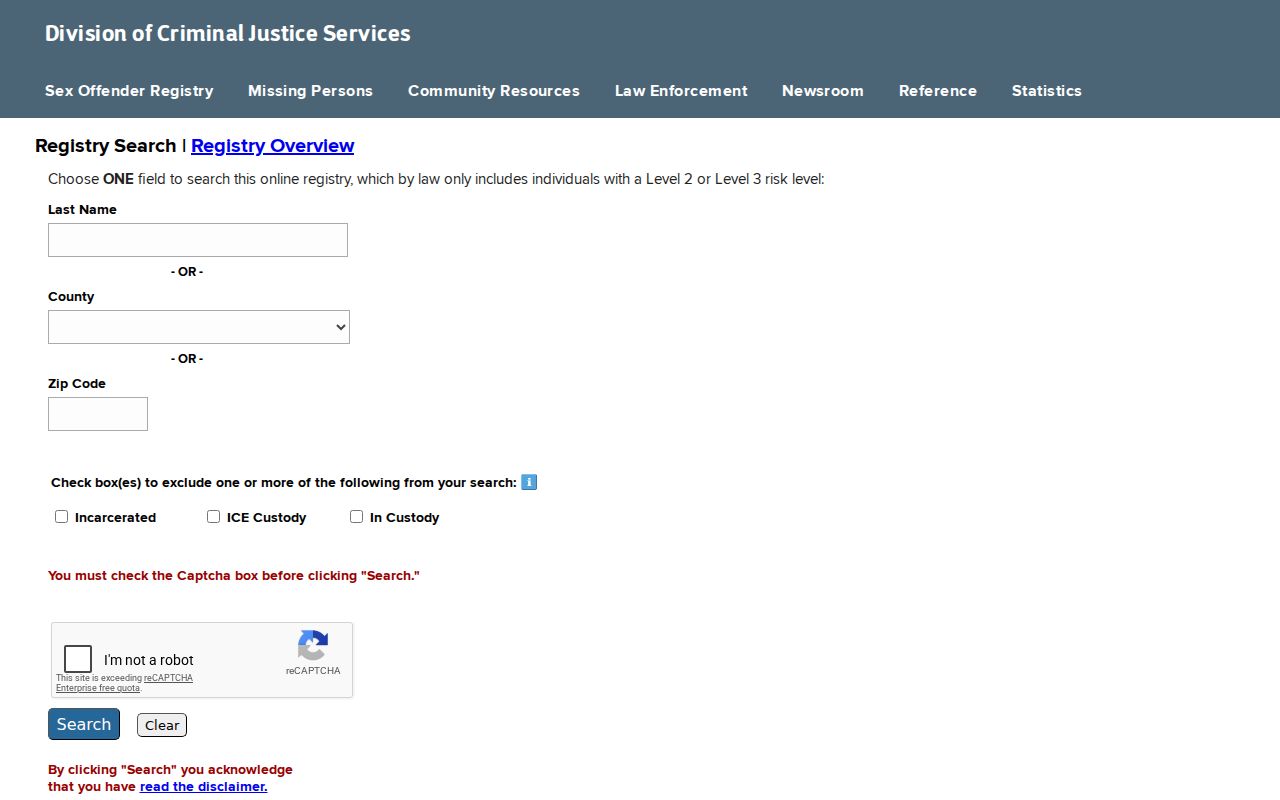
Some state public-safety systems are narrow, purpose-specific sources rather than resident rolls. The New York public registry search has its own notice and fields, while state and county custody information follows separate routes. Do not combine a registry result with a Clarence address into a claim about a household or a person's current location.
This official public registry search illustrates the distinct state record interface and its public-record notice.
For a Clarence question, rely on the source's stated scope, access date, and legal limits, then use the designated agency contact for any record-specific issue.