
Clarence Sources for Previous Residents
A backward address search uses more than one kind of record. Deeds trace recorded ownership. Directories and census schedules can identify people associated with an address. Maps and building files can date the physical property. The strongest answer labels each result by what it proves, because a former owner, a past occupant, an executor, and a permit applicant may all be different people.
| Address-history source | Coverage for the trail | Where to use it | What it can establish |
|---|---|---|---|
| Erie County deed books | 1808 to present; online index from 1986 and images from 1960 | Erie County Clerk | Transfers, named parties, book/page, and legal descriptions |
| Erie County mortgages | 1840 to present; online index from 1986 and images from 1980 | Erie County Clerk | Borrower, lender, lien, release, and property-description clues |
| Clarence assessment rolls | 2025 roll examined; 2024 and 2023 archive listings | Clarence Assessor | Current owner, mailing address, property location, parcel data, and deed book/page |
| Regional and county directories | 1870 regional; observed Erie County years from 1897/98 through 1949; suburban entry from 1991 | Grosvenor Room | Historical name, locality, address, family, and affiliation clues |
| Federal census | Released schedules through 1950 | Library databases and federal archives | Household members, ages, relationships, and period geography |
| Sanborn and building files | August 1946 Clarence set; building-file online coverage not located | Library of Congress and Town offices | Building footprint, use, physical changes, and permit chronology |
Start with the source closest to the period in question. A recent transfer usually begins with the parcel and deed. A much older household question may begin with an address book, census, or county directory, then return to the deed chain for the land identity. Note: The table separates ownership evidence from household evidence because neither one substitutes for the other.
Freeze the Clarence Parcel for Past Residents
Before looking for previous residents, capture the present parcel record from the Clarence PROS property search or the Erie County GIS viewer. PROS accepts an address or SBL, the tax-map parcel identifier. Its property result can supply the parcel location, current owner, mailing address, assessment information, physical inventory, and deed book/page. GIS provides the mapped parcel, SBL or PIN, address, owner and mailing fields, plus district and aerial layers.
| SBL or PIN | The stable parcel identifier that links the assessment record, map, and deed trail when an address label differs. |
|---|---|
| Situs or property location | The physical Clarence parcel address, which can differ from where the owner receives tax correspondence. |
| Mailing address | The correspondence field for the owner. It is not proof that the owner occupies the property. |
| Deed book/page | A pointer from the roll or parcel record into the recorded-transfer search. |
| Legal description | The recorded land identity, such as lot, map, subdivision, or metes-and-bounds language, used to test an old transfer. |
Copy the punctuation and zero-padding shown in the roll. The Town of Clarence has SWIS 143200, and the GIS schema describes an SBL as section, block, and lot. A parcel is the safer bridge when a historic source uses a different postal place, hamlet heading, or street form.
Trace Clarence Previous Residents in Erie Deeds
The Erie County Clerk Official Records Public Search does not search a street address directly. County instructions route the researcher from address to parcel record, then to a deed book/page or instrument number, and finally to the Clerk search. Search by Party Name, Book/Page, Parcel ID, Map Number, document type, town, date, or instrument/file number. A result identifies parties and document details, while image access follows the Clerk's current registered-user process.
The Clerk's search-help instructions show the party, book/page, and instrument routes used for a historical transfer. The official illustration represents search mechanics, not a result for a named individual or Clarence property.
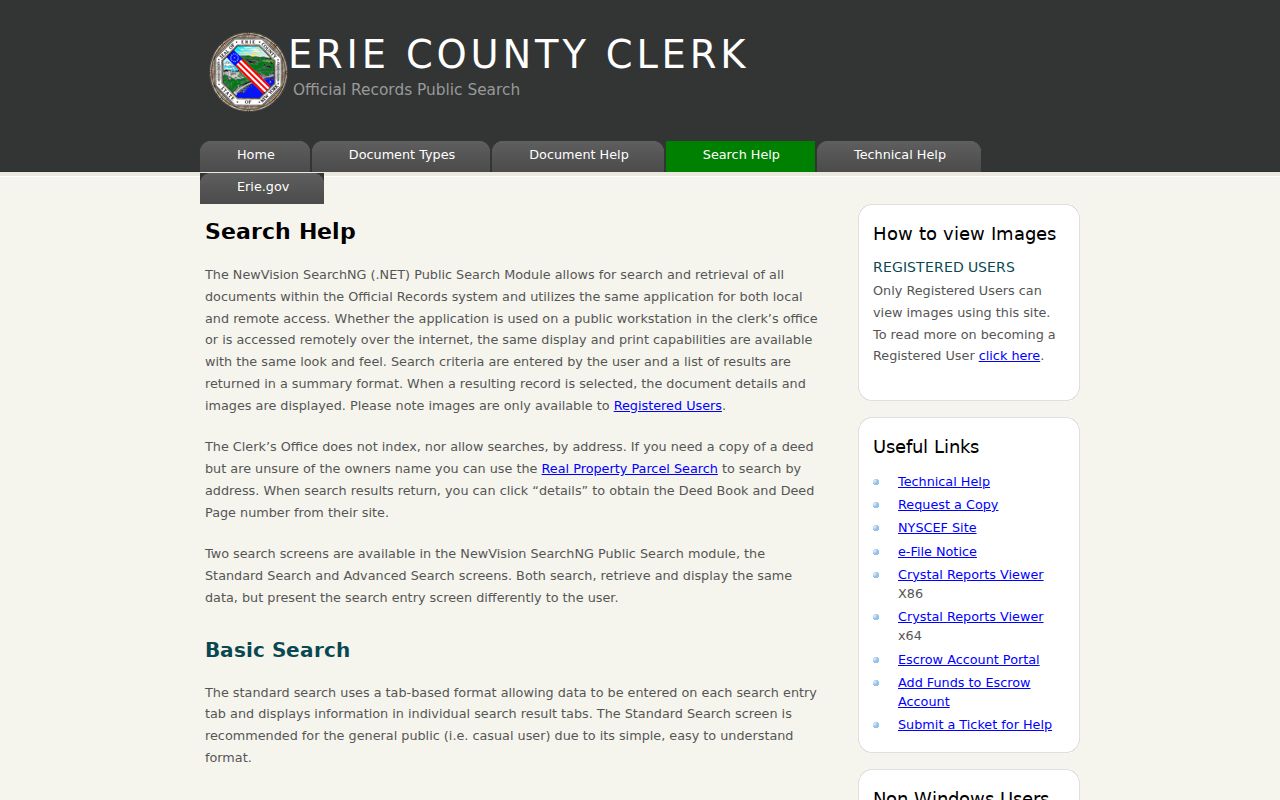
The recorded-deed trail works backward by following the seller on the current purchase into an earlier transaction. Match the legal description, parcel map, book/page, and party names before treating two documents as the same property. A transfer may involve a trust, estate, corporation, or only part of a parcel.
- Use PROS or GIS to copy the SBL, current owner, property location, deed book/page, and legal description.
- Locate the current owner's purchase deed by Book/Page, Party Name, or instrument number in the Clerk index.
- Read the detail for document type, date, parties, consideration, legal field, parcel/map data, and linked documents.
- Search the seller or grantor as a prior grantee, with name variants and an earlier date range.
- Repeat only when the parcel and legal description agree, then move to older office records at the online cutoff.
- Grantor and grantee
- The grantor transfers an interest in land. The grantee receives it. Their roles should be read from the document, not assumed from a name alone.
- Chain of title
- The linked sequence of recorded transfers for the same parcel, checked by legal description and parcel references as well as names.
- Legal description
- The formal land description recorded with the document. It can remain useful when a road name or postal label changes.
Clarence Previous Residents Beyond Online Cutoffs
The online trail has clear limits. Erie deed books begin in 1808, but the online deed index begins in 1986 and deed images begin in 1960. Mortgage books begin in 1840, with online mortgage images from 1980 and index coverage from 1986. For a 1960-1985 deed image or a 1980-1985 mortgage image, a Liber or Book and Page is needed. The alphabetical Graves Index volumes and office research are the documented older-record route.
For a known document, use the Clerk's request process or visit the public terminals in the basement and first floor at 92 Franklin Street in Buffalo. A request should identify the document type, owner or person, property address and municipality, approximate date, and a book/page or instrument number when known. The County Clerk records list describes the older deed and mortgage book coverage. A known book/page can avoid asking staff to perform a broad name search.
Paper does not mean lost. No documented evidence identifies a Clarence-specific courthouse disaster or a blanket loss of these books. The record sets were digitized on different schedules, so a blank online image field can reflect the record set and date rather than the absence of a transfer.
Clarence Previous Residents and Address Labels
A past resident may be tied to a Clarence parcel while the mailing or postal label says East Amherst, Clarence Center, Akron, or Williamsville. The property's situs address, the owner's mailing address, and the legal description are different record fields. The parcel SBL, map, and legal language are therefore more durable than a casual mailing label when a deed chain reaches backward.
No verified Clarence street-renumbering or street-renaming date was located. Do not fill that gap with an assumed conversion. Instead, preserve the old street form, check Road or Rd, Center or Ctr, Old or New, route numbers, and hamlet headings, then compare the road index, parcel map, deed description, and Town Historian material. The town ZIP map warns that construction can modify postal boundaries, which is another reason to check the parcel rather than guess from a ZIP.
When a parcel has split or merged, read nearby legal descriptions and linked documents before calling a prior transfer missing. A deed can describe a subdivision lot, map reference, or metes-and-bounds tract instead of the familiar street address. Note: Keep each historic address exactly as printed beside the stable parcel identifier used to test it.
Past Clarence Households in Directories and Census
Ownership is only one layer. Printed directories, reverse-address books, and census schedules can identify previous residents who were not buyers on a deed. The 1870 regional register, observed Erie County directory years, Buffalo Suburban catalog entry, Buffalo/Erie telephone books, and historical address books each supply a different clue. The collections themselves are described on the Clarence City Directory page; use them here as dated household evidence.
- Choose a directory close to the suspected occupancy and copy the name, address, locality, family notation, and page as printed.
- Use the address or criss-cross section when available, then search the name section for other details.
- Pair the clue with the nearest released federal census, especially 1900 through 1950, to check household members and approximate ages.
- Compare the printed address to the parcel record and deed sequence without assuming the directory household owned the property.
- Use an exact-date obituary request or a permitted probate file to close the timeline when the family and address details agree.
The library obituary request service accepts up to three requests in one transaction and needs an exact date. Staff search five days after the death date in local newspaper microfilm, usually responding in three to five business days without a guarantee. Probate can show an executor, heirs, or estate property, but confidential and restricted material is not an ordinary public result.
Clarence Address Records Date Building Form
The August 1946 Library of Congress Sanborn set has five Clarence sheets and related places for Clarence Center, Harris Hill Gardens, and Swormville. It is a physical-history source. A sheet can show a building footprint, materials, use, lot, and street context at that point in time. It does not name an owner or prove that a person lived there.
The Library of Congress Clarence map gallery can be compared with the 1940 or 1950 census, a 1949 county directory, deed records, and a later permit. Building and Planning files may date additions, pools, decks, demolition, plumbing or mechanical work, and changes in use, but an online permit index was not located. Request the file by exact address from the Town office.
Clarence Previous Residents Need Local Context
Some past residents appear only in the local-history layer. The Clarence Historical Society research center accepts focused questions about genealogy, photographs, and local property context. The Town Historian holds selected property histories, cemetery and church records, school material, maps, diaries, scrapbooks, oral histories, and local newsprint. Provide the surname, address or hamlet, approximate dates, and a specific question rather than asking for an undefined search.
The Historical Society is at 10465 Main Street; its research-center contact is 716-759-8575 and museum@clarencehistory.org. The museum's regular open hours are the first Saturday, 10-12, and second and fourth Sundays, 1-3, with tours by appointment. The Town Historian's reference library was reported under construction, so confirm access before travel. These sources can explain a property or family association, but they do not replace the recorded deed chain.
Lawful use. Clarence previous-resident research fits house history, family history, estate questions, and personal curiosity. Do not use historical or current information to stalk, harass, or harm any person.