
Clarence City Directory Collections
Clarence research begins with a regional shelf, not with a verified yearly book devoted only to the town. The Buffalo & Erie County Public Library directory shelf list directs researchers to an 1870 regional register, Erie County books, Buffalo Suburban volumes, Buffalo directories, and reverse-address material. Each collection has a different geography and list-making practice. A name found under Buffalo may signal a move, a business connection, or a regional address, so confirm it with the printed heading and address.
| Directory collection | Observed coverage | Research location | How it can help |
|---|---|---|---|
| Buffalo Erie County Register and Business Directory | 1870 | Grosvenor Room | Combined Amherst, Clarence, Lancaster, and Newstead listings, including farmers and businesses |
| Erie County directories | 1897/98; 1916/17; 1917; 1924, 1927, 1929, 1931, 1934, 1936, 1938, 1941, 1949 | Grosvenor Room | County and town headings for names, addresses, and affiliations |
| Buffalo Suburban directories | 1991 to present catalog entry | Grosvenor Room | Later suburban name and address clues that include a Clarence entry |
| Buffalo City Directories | 1832-1913 digitized run | New York Heritage | Free online books for Buffalo-linked households and front matter |
| Buffalo Address Book and Family Directory | 1883-1916 | New York Heritage and Grosvenor Room | Address-to-name and family-directory context, not a verified Clarence scan |
The observed Erie County years are not proof of a complete annual run. The same caution applies to the Buffalo Suburban catalog entry. Ask staff to confirm the shelf, gaps, and town coverage for the year that matters. A city directory result is a dated historical lead, not legal proof of residence.
Regional Books Behind Clarence City Directory Searches
The 1870 register is the clearest early example of the regional approach. Its Clarence entry sits with Amherst, Lancaster, and Newstead, and the shelf list says the volume includes farmers and businesses. That context matters when a nineteenth-century name fails to appear under a modern town label. The boundaries themselves changed over time: Buffalo separated in 1810, Alden and Newstead in 1823, and Lancaster in 1833.
- 1870: use the combined Buffalo Erie County register for an early regional name or farm connection.
- 1897/98 through 1949: check the observed Erie County directory years around the event date.
- 1886 through 1975: consult Buffalo/Erie telephone directories when a phone or household clue is stronger than an address, while allowing for the noted 1952 gap.
- 1991 onward: ask for the Buffalo Suburban entry when the search belongs in the later suburban period.
For a person who may have crossed town lines, search the locality printed in the source as well as Clarence. Historic maps, census geography, and deeds can then settle whether a familiar name refers to the same household. Note: A modern postal label should not be substituted for the jurisdiction printed in an older volume.
Digitized City Directories Near Clarence
New York Heritage's digitized Buffalo City Directories collection is the main documented online historical-directory route. It offers 77 items from 1832 through 1913. Those books are valuable when a Clarence family had a Buffalo address, a business tie, or a move that needs pinning down. They are not a substitute for the regional and county material held in the library.
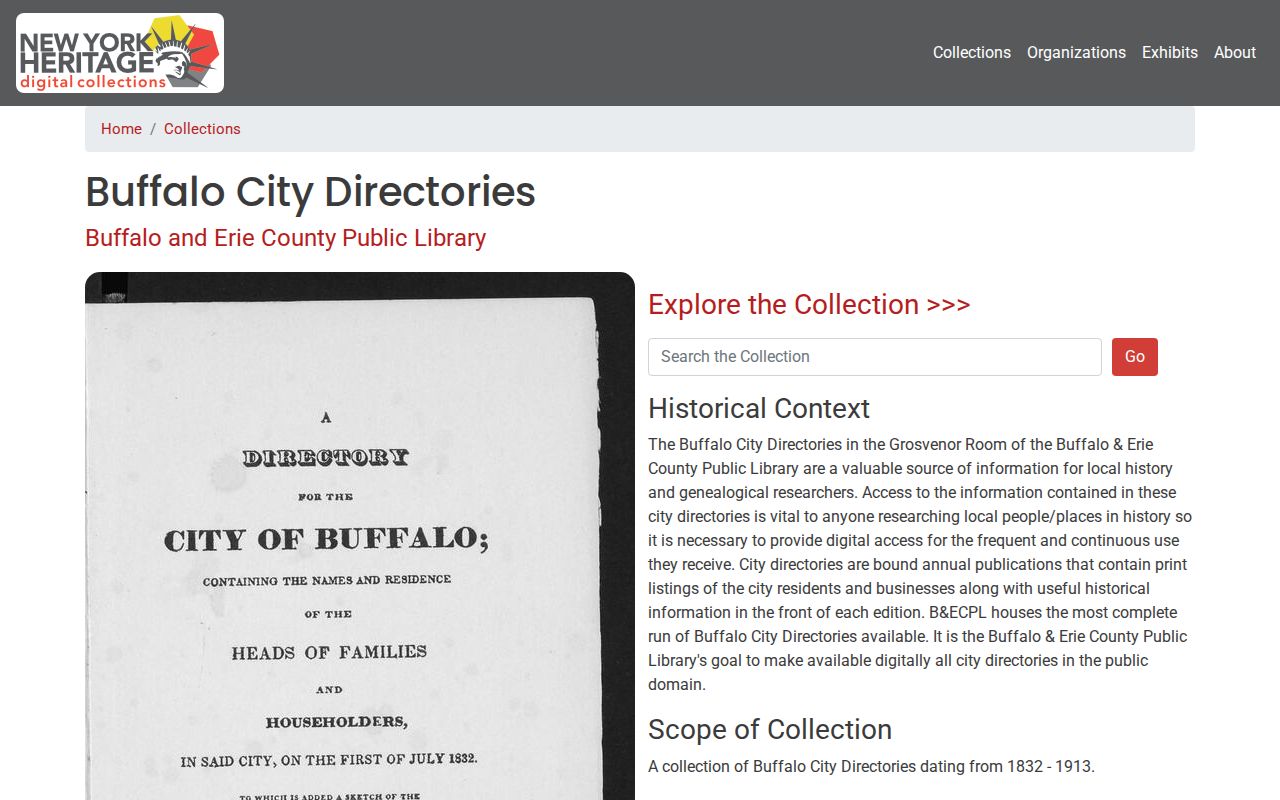
New York Heritage hosts the collection image and the browsable annual books. Browse the volume's front matter as well as its name pages, since maps, local institutions, and abbreviation conventions can explain a result. The related Buffalo Address Book and Family Directory collection supplies 14 digitized items from 1883 through 1916 and is the better online starting point for an address-first clue.
Neither digitized collection establishes a separate scanned Clarence series. Keep the source title, year, page, printed locality, and exact spelling with every find. That small record makes it possible to return to the book when a surname, street suffix, or family notation needs another check.
Clarence City Directory Research at Grosvenor
The Grosvenor Room genealogy collection at the Central Library is the deeper in-person stop for the directory shelf. It holds non-circulating local, family, and military histories alongside church and cemetery records, newspapers on microfilm, local-history files, vital-record indexes, and yearbooks. The directory guide places the room at 1 Lafayette Square in Buffalo and lists 716-858-8900. Closed-stack material is retrieved by staff, commonly with a short wait, and fragile volumes may not be copied.
Grosvenor Room
Use the directory shelf list, microfilm, census databases, and non-circulating special collections. The guide says no appointment or library card is needed, but current hours should be checked before travel.
Clarence Historical Society
The research center at 10465 Main Street accepts focused questions about local photos, genealogical material, and property history. Give a surname, hamlet or address, approximate dates, and the specific record sought.
For a no-hit name, the Town Historian can help identify the relevant cemetery, church, school, or property-history source. Holdings include photographs, military records, selected property histories, local newsprint, oral histories, maps, diaries, and scrapbooks. Confirm access before visiting because the reference library was reported under construction.
Reading a Clarence City Directory Entry
A printed entry should be read as a bundle of clues, not as a modern profile. The New York Heritage description of the historical address and family books says a typical entry may include a surname and given name, street address, spouse or family notation, occupation or affiliation, a later telephone number, and sometimes a household-status mark. Earlier and later volumes do not list people in the same way, so an omission can reflect the publisher's convention rather than a move.
| Name as printed | Record initials, suffixes, and alternate spellings exactly before deciding two entries match. |
|---|---|
| Street and locality | Compare the address, town or hamlet heading, and any ward or section to the right period. |
| Family notation | A spouse, widow, or household relationship can separate people with the same name. |
| Occupation or affiliation | Treat it as a date-specific association that can guide newspaper or organization research. |
| Phone or household mark | Use only when the volume prints it, and keep the page citation with the transcription. |
- Criss-cross directory
- An address section arranged by street, used to move from a printed address to a listed occupant or household clue.
- Householder index
- A name-oriented list that may emphasize the principal household member rather than every person at an address.
- Abbreviation key
- The volume's explanation of its short forms. Read it before expanding an address, relationship, or business notation.
Start with the name section, then reverse the route through an address section when one exists. Search initials and surname variants. No image-level Clarence entry has been located for transcription, so no sample person or address is invented here.
Clarence City Directory Dates Need Boundary Checks
Directory years work best when paired with the geography of their time. Clarence began as a town in 1808, but its earlier boundaries were much larger than the present town. A nineteenth-century household can surface under Clarence, Amherst, Lancaster, Newstead, Alden, or Buffalo depending on the event year. The printed heading, not today's map, tells the first part of the story.
Federal census releases provide useful checks for 1900, 1910, 1920, 1930, 1940, and 1950. Compare household members and approximate ages before connecting entries across an address change. Buffalo newspapers on microfilm reach back to 1818 in the Grosvenor guide, while the library's obituary request works best with an exact death date. Note: A directory line and a census line should agree on more than a surname before they become one household history.
Trace Clarence City Directories Across a Household
Tracing a household is a year-by-year comparison job. Begin with the most certain name and address, then collect nearby directory years rather than jumping from one distant decade to another. Record the details as printed. An owner in a deed can differ from the occupant in a directory, and an assessor mailing address can differ from the property location.
- Find the household in the 1870 regional register, a nearby Erie County year, or the suburban run that fits the period.
- Copy the exact name, address, town or hamlet heading, family notation, affiliation, phone, year, and page.
- Check the next available directory year and write down each change rather than silently normalizing the address.
- Pair the strongest directory clue with the matching federal census year to test names, ages, and household members.
- Use an obituary, burial record, or probate file to close a trail only when the date and family details line up.
A disappearance can mean a move, a death, a different spelling, an unlisted household member, or a gap in the series. The modern address-record trail belongs on the Clarence Street Directory; it can help anchor a later property without turning a historical directory clue into a current-residency claim.
Clarence Directory Records Gain Protection
In 2026, the Town's State of the Town reported that Clarence records were being organized in acid-free paper and boxes with help from volunteers, clubs, and students. That preservation work is a useful local history signal, but it is not a new online directory index. Contact the Town Clerk or Historian about a specific record rather than assuming that a preserved item has been digitized.
The 2026 State of the Town report gives the documented preservation context. It complements the library shelf and historical society holdings: one keeps local material available, while the other supplies the catalog, staff assistance, and source-by-source access needed to use it carefully.