
Clarence Resident Lookup Records
A single official result rarely answers every identity question. The Clarence PROS property search can connect an owner name to a parcel, while New York's voter tool is a person-oriented confirmation route with its own limits. Court portals identify a filing and its parties, not where someone lives. A vital record may establish an event only when the requester meets the statutory eligibility rules. Start with the source that fits the fact you need, then keep the result identifier and access date with your notes.
| Record route | Fact it can support | Clarence or state custodian | Access boundary |
|---|---|---|---|
| Parcel and assessment record | Current owner, property location, mailing address, SBL, and deed reference | Clarence Assessor through PROS | Public search; owner is not a full occupant list |
| Voter registration lookup | A lawful registration or poll-site match for the named person | New York State Voter Registration Information | County, name, date of birth, and ZIP are requested; protected voters may be absent |
| Court index | Case number, party names, court, type, status, and allowed calendar information | NY Courts WebCivil Local | Portal coverage and sealed-file rules vary by court |
| Vital-record route | A birth, death, marriage, divorce, or burial event when access is authorized | Clarence Town Clerk or New York State Department of Health | Certified and genealogy copies have separate eligibility rules |
| License or entity record | A public credential or organizational connection | New York Department of State licensee search | A listed business or service address does not prove residence |
For a current ownership clue, run the name in PROS and preserve the parcel SBL, property address, mailing address, and deed book or page. For an old family question, use a library directory or obituary before trying to treat a recent owner field as historical proof. The Erie County Clerk’s index can then connect a party name to a recorded document, but the clerk’s address workflow is indirect: parcel first, then book/page or instrument number, then the index.
Clarence Voter Lookup Rules
The state voter form asks for county, last name, first name, date of birth, and ZIP. It is not a browseable list of households. New York Election Law §3-103(5) limits voter-registration-record use to an elections purpose, and Election Law §5-508 protects qualifying voter records. A match can help distinguish two people with the same name, but a missing result can reflect a name change, a move, a protected record, or an incomplete search rather than a firm conclusion.
The state voter lookup is the useful route for an individual inquiry. Erie County’s voter-file FOIL process is different: it can offer geographic T/W/D and address-related choices, but the requester must state an elections purpose. Do not convert that limited records channel into a general name-and-address directory. The statewide VEDA system separately handles aggregated election information, not individual voter files.
The state’s voter registration form illustrates the person-and-ZIP search that is appropriate for this check.
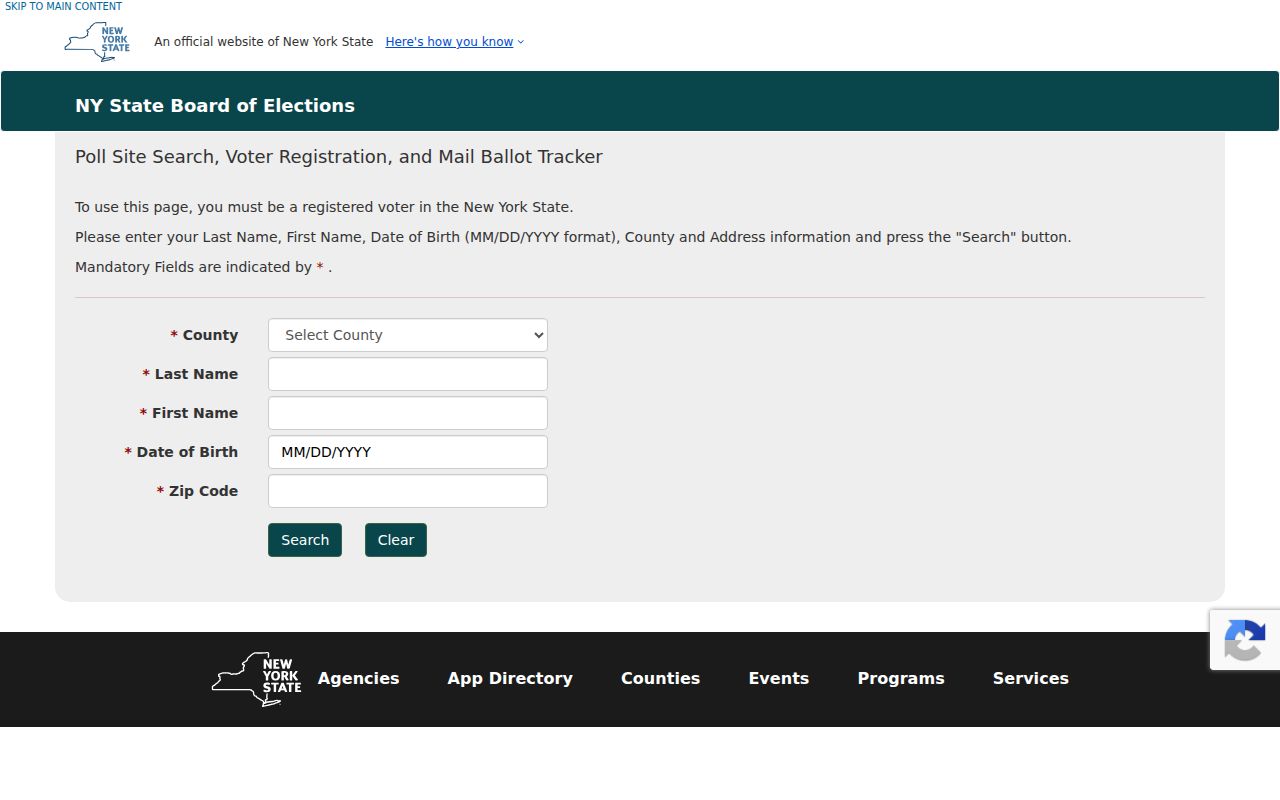
Use the displayed fields to narrow a known person, then record the date of the search rather than assuming a result stays current.
Note: Voter information is a narrow confirmation tool, and protected or purpose-limited records should never be treated as a public household roster.
Clarence Court Name Searches
Clarence Town Court and other local-court matters route through WebCivil Local, which offers Index Search, Party Search, Attorney/Firm, Judge, calendars, and available-court options. The controls change with the selected route, but party searching uses a name with court and date choices. A result may show an index or case number, party names, court, case type, status, and permitted calendar or disposition information. It proves a filing connection, not current residence.
| Portal result field | How to use it carefully |
|---|---|
| Index or case number | Keep it for a targeted clerk or file request. |
| Party name | Compare initials, suffixes, and spelling variants before joining it to a parcel. |
| Court and case type | Use them to select the right clerk and understand what portal rules apply. |
| Status, calendar, or disposition | Read only as the portal permits; it does not establish a current address. |
For estate or heir research, WebSurrogate has name, file, old-index, index-book, and will search modes. It provides remote images for filings on or after February 19, 2014 when available; older unrestricted material can require a courthouse public computer. Family, sealed, youth, adoption, and other protected matters have added restrictions. A court clerk can provide a plain or certified copy only under the rules for that file.
Clarence Vital Record Eligibility
Vital records are not an open name-and-address index. The Clarence Town Clerk records route handles local birth, death, and burial material, while a marriage record is best started with the local clerk if the license was issued there. New York State Department of Health serves the statewide route outside New York City. Ask the local registrar whether the event was recorded by Clarence, because a Clarence, East Amherst, or other postal label does not by itself identify the correct municipality.
For genealogy copies, New York generally requires a birth record to be at least 75 years old with the person known deceased, a death record to be at least 50 years old, and a marriage record to be at least 50 years old with both spouses known deceased. Direct-line descendants may be able to waive a waiting period with the required proof. Certified copies have relationship, identification, lawful-right, or court-order limits. Public Health Law §§4173 and 4174 and Domestic Relations Law §§19 and 20 set the relevant boundaries.
The NYSDOH genealogy application asks for the record type, names, approximate year or search period, place, applicant contact details, requested copies, and direct-line documentation where applicable. A $22 fee covers a one-to-three-year search with an uncertified copy or no-record notice; broader ranges cost more. State genealogy processing can take eight months or longer, so a known Clarence event may warrant a local-clerk inquiry first.
Note: An uncertified genealogy copy can support family-history research, but check the current eligibility rule and named custodian before ordering.
Verifying a Clarence Resident
Verification works best as a controlled chain rather than a series of loose name hits. Anchor the name to a specific parcel or historic address, then test it against a record kept for a different purpose. An owner listed on an assessment roll is an ownership clue. A directory entry can be a historical association. A court party is a litigation clue. Keep those labels separate until a date, address, spouse, age, SBL, or document identifier connects them.
- Search the name and likely spelling variants in PROS. Save the SBL, property location, owner mailing field, and any deed book/page reference.
- Use the Erie County Clerk’s Official Records Public Search with a party name, Town filter, date range, or book/page to find the related instrument.
- Check WebCivil Local or the relevant court route with the name, initials, and suffix. Preserve the case number instead of copying assumptions from the party line.
- Use an eligible vital-record, obituary, probate, or library route only to test the particular event or historical connection still in question.
- Docket
- A court’s running case record, usually identified by an index or case number and limited by that court’s public-access rules.
- Index versus image
- An index gives searchable fields such as parties, date, and identifier; the underlying scan or file can have a different online cutoff or access rule.
- Certified copy
- A copy issued by the custodian with official certification. Eligibility, fees, and use differ from an informal index result.
For older names and addresses, the Buffalo & Erie County Public Library’s Grosvenor Room holds regional directories, microfilm, yearbooks, and local-history material. A historical name that needs present-day confirmation can be checked against the Clarence city directory collections before a current parcel or court search is attempted.
Clarence Lookup Result Fields
Same-name mistakes are common. Erie Clerk instructions support name and party searching, but a person can appear under initials, punctuation variants, a former surname, or a suffix. Run the broader spelling search first, then narrow by Town, date range, document type, SBL, legal description, or book/page. The Clerk index, assessor record, and court result each supply a different identifier. Matching the identifiers is more reliable than matching the first name that looks familiar.
When an online search ends, use the right fallback. The County Clerk can take a targeted copy or search request for a book/page or instrument. A court clerk can explain the file route. The Town Clerk, library, Town Historian, or Clarence Historical Society can help identify historical holdings when the question has a date span and a defined record target. Include name variants, locality or hamlet, and the fact you are trying to confirm, not a broad request for every record about a person.
Note: Mark results as located, confirmed, historically associated, or not located so one tentative match is not silently upgraded into a current-residence claim.
Clarence Records Request Path
New York Freedom of Information Law, Public Officers Law Article 6, §§84-90, gives a route to agency records that are not otherwise exempt. It does not override the statutes that restrict vital records, protected voters, sealed court files, or private motor-vehicle data. A focused request to the right custodian is more useful than a general person search. Name the record, date span, Town of Clarence connection, and requested delivery format.
Under the official FOIL guidance, an agency generally grants, denies, or acknowledges a request within five business days. An acknowledgment normally gives an estimated determination date, generally within 20 additional business days unless circumstances require an explanation. A denial may be appealed within 30 days, and the appeal determination is due within 10 business days. Paper copies up to 9 by 14 inches generally may not exceed $0.25 per page, though Clarence publishes a $1-per-page rule for its own local FOIL copies.
For a deed or older land image, use the Erie County Clerk request procedure after identifying a book/page or instrument. For an eligible vital event, use the current DOH or local-clerk application. Requests for court material go to the relevant clerk. Each route has its own access test, and a FOIL request is not a shortcut around it.
Clarence Protected Resident Boundaries
New York’s Address Confidentiality Program, under Executive Law §108, provides an eligible participant with a substitute mailing address and mail forwarding. The participant’s actual residence is confidential, while program participation itself is not. Membership lasts four years, and state and local agencies must safeguard the actual address. The Department of State ACP information is the appropriate source for eligibility and program questions.
Protected voter records, sealed cases, confidential vital material, and ordinary household details can also leave a record trail incomplete. Utility customers, delivery data, DMV addresses, and every person at a parcel are not part of the ordinary public chain. Do not infer that a blank screen means someone is absent from Clarence. It can mean a protected address, a name variation, a sealed matter, an offline record, or no indexed result.
Limits on Clarence Resident Lookups
Official records are strongest when they are read for their stated purpose. A parcel owner may receive tax mail elsewhere. A registration result is purpose-limited. A business or professional search can support a public affiliation but not a private residence. Court indexes may omit sealed or restricted matters. Certified vital copies have eligibility controls. Treat each result as one documented fact, then seek a second source before making a personal or family-history conclusion.
A compiled commercial profile can merge stale property, court, directory, and marketing data, which increases the risk of confusing people with the same name or publishing a protected address. Go back to the assessor, clerk, court, election office, vital-record custodian, library, or archivist for the record that actually supports the claim. If an official record appears wrong, ask that custodian about its correction or redaction process.